

The Biological vs Non-Biological argument just won't wash (Part Two)
Completing this review of the Supreme Court's 16 April Judgment ...

The Biological vs Non-Biological argument just won't wash (Part One)

I am considering changing my name by deed poll once again. I’m thinking of something plainly descriptive and suitably impersonal like “Non-Biological Person”. The EHRC with its transphobic backers on both front benches of the House of Commons (as well no doubt, as the TERF’s and those on there religious right here and abroad) has just published “An inte…
(continued from Part One …)
Their Justices next insulting course of action is to address single sex services. Amongst the statements are that medical or counselling services need to be proscribed for the safety of women, for religious observance or for the autonomy, privacy and dignity of “the two” sexes. Peculiarly, as a trans woman, I have never needed to be told that I don’t have to concern myself with any invitation to provide a cervical smear for cancer testing and I would assume that a preponderance of trans men likewise understand that they will never be at risk of developing prostate cancer. This said, I will be extremely unimpressed if when I am next invited for breast-screening I have to wait whilst a man arrives because legally a woman is not permitted to arrange my breasts between the plates of the mammography scanner (for fear they might attack her, obviously). Likewise, were I to be raped because a man “mistook” me for a “biological woman” would I wish to be interviewed by another man, who would determine whether or not I’d been raped in contravention of my protected characteristic of gender reassignment … one tasked with the challenge of empathising with my experience of being raped; and given the task of providing me with pastoral care … a conciliatory hug, perhaps? Particularly NOT.
Their Justices now suggest that even though a trans person might be entitled to participate in single sex services (the “gender reassignment exception”) that duty-bearers would not discriminate against an individual if to do so is a “proportionate” means of achieving an aim. This essentially gives single sex women’s service providers the right to exclude trans men from receiving those services if it is felt that the fear that the appearance of a trans man might engender in “biological” women outweighs the importance of providing the trans man with the services made available to his peers. So trans women are to be excluded from women only spaces and it’s perfectly acceptable to exclude trans men too if the service provider claims that in some sense that exclusion is “proportionate” to attain purity in order to deliver discrimination for a different purpose.
Throughout the later sections of its judgment, the Justices weaponise the Gender Recognition Certificate. By deeming that only those who possess a GRC might have a legal right to access single sex accommodation for example they exclude the right of both those with and those without a GRC to access those spaces based on the fact that a service provider would be unable to distinguish between those who have a GRC and those who do not. There are 262,000 trans people in the UK. A total of 8,464 full certificates had been granted in the UK up to the end of March 2024, the last accurate data available. Ten are held by individuals who are in prison (a reduction of thirteen from the previous records, indicating either that those thirteen are no longer in custody or that they have abandoned their claim to be trans). However you look at the level of adoption of the GRC by 3% of trans people shows the complete lack of a will amongst trans people to see the point of a piece of paper which permits them to change their birth certificates. It also accentuates the injustice of using the ability of an individual to present a certificate or not, and the fact that they are indistinguishable from those who cannot, as a method by which to deny rights to all.
Going back to the original question posed by this appeal … the Supreme Court was asked to determine whether an attempt by the Scottish Ministers to draft an amendment to their own legislation which was based on a certain reading of the 2010 UK Equality Act was permissible. The Court could simply have indicated that the Equality Act could not be read in the way the Scottish Ministers had construed it and so trans women could not account for any part of the 50% quotient of women on the non-executive board. Instead they next turned their attention to whether single sex higher education institutions could admit trans members of that sex. Once again at Paragraph 228 they talk about the harm of admitting individuals who are GRC holders “whose biological sex is likely to be readily identifiable”, whilst excluding their peers who do do not hold a GRC, “whose circumstances may be materially indistinguishable”.
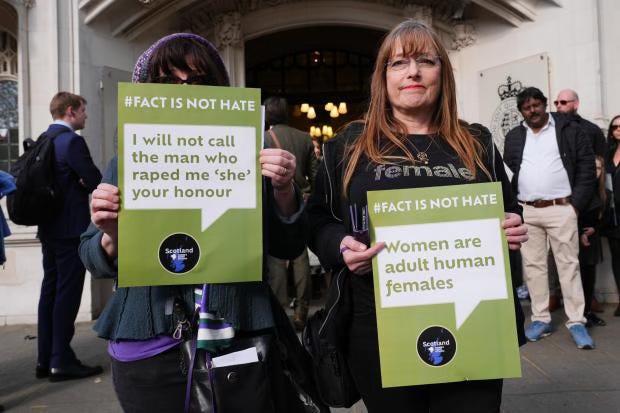
All of a sudden it would seem that everyone is supposed to be expert in sexing trans folk. One wonders what the actual success rate amongst the general public would be, after all it’s a long time since I saw a trans woman proudly or absentmindedly allowing her male member to swing free beneath a mini-skirt in order that her “ biological sex” be “readily identifiable”. A (much younger) man recently told me that I am “beautiful” and “sexy” without adding the rider “for a non-certified, trans woman that is”. I am sure that I am not alone in finding the entire tone of the Supreme Court’s judgment tasteless, cruel and pejorative. They assume that trans people can easily be “read” as belonging to the gender first assigned to them whereas the success of modern surgical techniques coupled with the fact that post 2010 children felt empowered to come out as trans so that puberty blockers could be provided permitting overall, a far more satisfactory transition and result then I, for example, achieved. Even so I am (other than when using the phone) ever mis-identified as male as physically my transition was largely successful.
“Single characteristic” associations and charities get the same treatment as all the other areas of public life which their Justices determine should now be “out of bounds” to members of the trans community. Then sports, then the armed forces …
Finally the Court addresses its reasons for believing that its judgment is entirely fair to trans people. At Paragraph 251 the Justices state that were an employer to discriminate against a trans person because of what they perceive to be the biological sex (i.e. if they perceived that a trans woman were a woman and for a vacancy at work preferred a man to her) then she would have a claim for direct discrimination by comparing her treatment to someone who is not of her acquired gender (i.e. to that of a “biological” man). The argument is that you compare the treatment of the trans woman with the treatment of a cis man who does not have the protected characteristic of being gender reassigned or a trans man.
So that’s fine then … as a trans person you have direct and indirect discrimination protection … all you have to do is challenge your employer, who believes you to be a woman, inform him or her that you are in fact a “biological” man and that you’d like to be treated as they would’ve treated any other man in your position.
Schimpuls!
I think I might just take the knock of being overlooked, demonstrate to my employer that I was always the better candidate for the job; and retain my self respect, privacy and integrity.
In summarising their work at Paragraph 265 their Justices have the following observation:
“The interpretation of the EA 2010 which we conclude is the only correct one, does not cause disadvantage to trans people, with or without a GRC. In the light of case law interpreting the relevant provisions, they would be able to invoke the provisions on direct discrimination and harassment, and indirect discrimination.”
Well there’s a reason why this is the highest court in the land I suppose …